
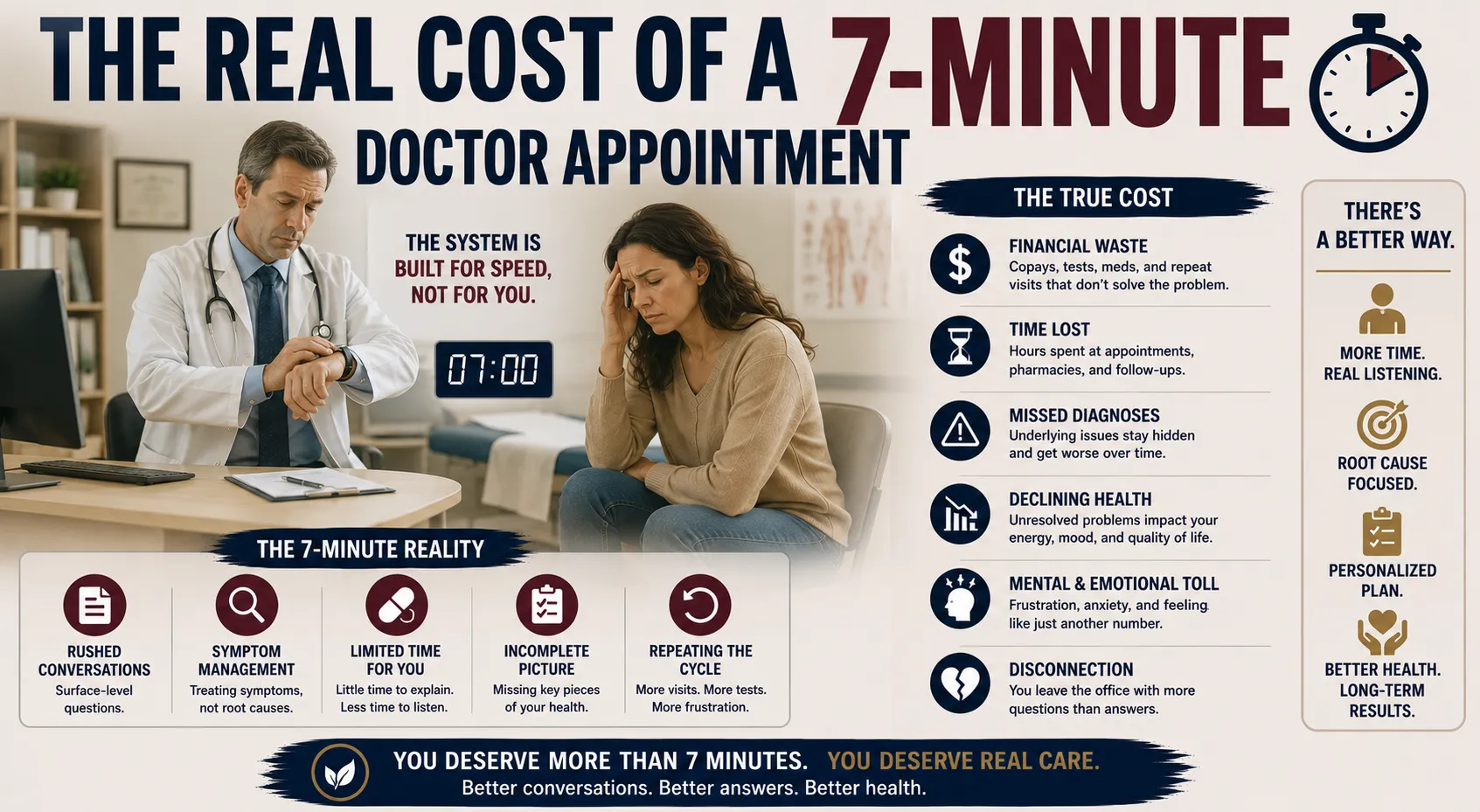
She waited six weeks for that appointment.
Scheduled it two months out. Rearranged her workday. Sat in the waiting room for forty minutes past her scheduled time.
The doctor saw her for nine minutes.
She left with a prescription for something she wasn’t sure she needed, a referral to a specialist she’d have to wait four months to see, and the quiet, demoralizing feeling that she’d just been shuffled through a machine that had no particular interest in solving her problem.
This is not an unusual experience. According to clinical observation from providers working in functional medicine, primary care visits average 7 to 10 minutes. That isn’t an exaggeration and it isn’t a fringe critique. It’s the documented reality of how mainstream medical care is delivered in the United States.
The question worth asking is what actually happens inside those 7 minutes, and what that structure costs patients.
What 7 Minutes Can Do
Seven minutes is enough time to address one straightforward problem.
You have a UTI. Here’s an antibiotic. You have a clear bacterial infection. Here’s another one. You’ve fractured your wrist. Here’s a referral for imaging and orthopedics.
Acute, single-system, identifiable-by-symptoms problems: conventional medicine handles these well. Seven minutes is functional for this use case.
The problem is that most patients who feel chronically unwell don’t have single-system, acute problems. They have fatigue that’s been building for two years. They have gut symptoms that cycle between constipation and bloating. They have brain fog that’s affecting their work. They feel like someone turned down the dimmer on who they used to be.
These presentations don’t fit into 7 minutes. The differential diagnosis for fatigue alone includes more than 30 possible drivers. Exploring any of them meaningfully, asking follow-up questions, ordering targeted tests, and synthesizing the answers into a coherent clinical picture, requires time that doesn’t exist in the current model.
So patients with these presentations get one of a few outcomes: patient blame (“you’re a busy mom, no wonder you’re tired”), a referral that adds months to the timeline, a prescription for something that addresses the discomfort without touching the cause, or a statement that their labs look normal and they should feel fine.
The Structural Reason This Happens
It would be easy to blame individual doctors. That misses the point.
Primary care physicians in high-volume practices often see 20 to 30 patients a day. To keep the schedule running, each appointment has to stay tight. Providers who want to spend more time with a patient have nowhere to put the remaining 19 patients waiting behind them.
The infrastructure of the appointment is also constrained by what insurance pays for. Insurance reimbursement is structured around diagnostic codes and treatment interventions. Time spent explaining, educating, exploring, or synthesizing doesn’t have its own billing code. The 7-minute appointment isn’t just a scheduling problem. It’s a financial model problem.
Dr. Rose, a naturopathic physician with 20 years of clinical experience, puts it directly: “The system is somewhat broken. The visits are 7 to 10 minutes, doctors are limited by what insurance allows, and people aren’t being heard. It’s a systemic thing.”
Colin Renaud, DC, PA-C adds the supply side: “Medical overhead is massive. If a doctor’s not seeing 40 patients a day, they can’t support the overhead of that practice. So that’s why you’re given five minutes, and they’re just looking at one lab that the insurance will pay for, and you’re okay, see you in six months.”
These aren’t bad doctors. They’re doctors inside a system with almost no structural slack for anything beyond rapid triage.
What Gets Lost in 7 Minutes
The things that are most likely to explain complex chronic illness are exactly the things that require time to surface.
Context takes time. When did this start? What else changed around that time? What was happening in your life in the years before your symptoms appeared? These questions matter clinically. Chronic illness often has a chronology. A period of severe stress, a significant loss, a decade of poor sleep, a time of nutritional deprivation: these precede dysfunction in ways that point toward root causes. You can’t get this history in 7 minutes.
Pattern recognition takes time. One symptom in isolation might mean nothing. Fatigue combined with cold intolerance, combined with hair thinning, combined with constipation, combined with gradual weight gain: that’s a thyroid pattern. Recognizing and acting on that pattern requires actually assembling the pieces. A 7-minute visit gets one or two pieces.
Testing decisions take time. What’s worth measuring depends on what the picture looks like. If there’s a pattern suggesting hormone dysfunction, that directs the lab order. If the picture suggests adrenal burnout, that suggests different testing. Good clinical decision-making about what to test requires enough time to understand the patient. Without that time, providers often fall back on the standard panel, which is the only thing that can be ordered in the time available.
Explanation takes time. A patient who understands why their body is doing what it’s doing is a fundamentally different patient from one who’s handed a prescription and shown the door. They’re more likely to follow through. They’re more likely to make the dietary changes that matter. They’re more likely to stay engaged in the process. None of that happens in 7 minutes.
The Downstream Costs
The 7-minute appointment feels cheap in the moment. The costs appear later.
A patient with undiagnosed perimenopausal hormone dysfunction who’s been told she’s “just stressed” for three years isn’t saving money. She’s spending it: on follow-up appointments that go nowhere, on specialists who each treat one symptom, on medications that address the discomfort without touching the cause, on sick days, on the diffuse cost of being chronically unwell and underperforming in every area of her life.
Colin Renaud, DC, PA-C described a patient with perimenopause that had been missed: “It completely changes who they are. It changes the way they think. It changes their physical abilities, their physical strength. It changes their sex drive and that could change their relationship. If your cognition is not as sharp, then you might not do your job as well or you might have to stop doing certain activities.”
All of that has a cost. It’s not visible on a single billing statement, but it’s real.
The conventional answer to this: “We can get you an appointment in 6 months.” The functional medicine answer: comprehensive testing before the first appointment, a 60-minute initial consultation, and a treatment plan starting day one.
The Lifespan Versus Health Span Gap
One of the clearest ways to understand what short, reactive appointments cost is through the lens of health span.
Lifespan is how long you live. Health span is how well you live through those years.
Conventional medicine, in its current form, is oriented toward lifespan. It intervenes when disease is present. It manages crises. It does this well.
What it doesn’t do well is optimize health span. It doesn’t ask: will this 52-year-old woman be sharp, strong, and well at 72? It asks: does she have a diagnosable condition right now? If no, the appointment is over.
Dr. Rose frames the preventive opportunity directly: “If we can catch a woman in her perimenopausal years and do this now, it’s like a gift to your 65-year-old self, your 75-year-old self. That’s the ultimate preventive medicine.”
That conversation doesn’t happen in 7 minutes. It might not happen in a system built entirely around reacting to existing disease.
What Changes When the Appointment Is Long Enough
A longer appointment doesn’t just give the patient more time with their provider. It changes what’s clinically possible.
When a provider has an hour, they can build a complete picture. They can review comprehensive labs that came in before the appointment. They can trace a timeline. They can explain what’s happening and why. They can design a treatment plan that addresses multiple drivers simultaneously rather than triaging to the most urgent symptom.
Patients who go through this process often describe the same reaction: why has no one ever said this to me before? The information isn’t exotic. The physiology of energy, hormones, thyroid function, and gut health is well-established science. But they’ve never had a provider with enough time to connect the pieces and explain them.
That explanation is not a luxury. It’s what makes care effective. A patient who understands their situation is an active participant in their recovery, not a passive recipient of instructions they don’t understand.
The real cost of a 7-minute appointment isn’t the copay.
It’s every year of chronic symptoms that could have been investigated, explained, and addressed in an appointment that actually had time to do the job.
About the Author: This article was written by the clinical education team at Med Matrix, a functional medicine clinic in South Portland, Maine. Med Matrix serves over 3,000 patients with a provider team that specializes in root-cause testing, hormone optimization, and personalized treatment plans.